A customer once asked us to just “leave the old battery” after a swap so he could sell it to a scrap guy who does rounds through his neighborhood in a pickup truck. He wasn’t trying to break any law — he genuinely didn’t know that’s exactly the kind of informal collection Dubai has spent years trying to shut down, because it’s how battery acid ends up dumped down drains instead of recycled properly.
Here’s the direct answer: used car batteries are legally classified as hazardous waste in Dubai. The rule sits on two layers — Federal Law No. 12 of 2018 on Integrated Waste Management sets the national baseline for hazardous waste, and Dubai Municipality’s own Circular No. 3 of 2018 spells out exactly how used lead-acid batteries must be transported, recycled, and disposed of within the emirate. You cannot throw one in a regular bin, and you’re not supposed to hand it to just anyone claiming to “recycle” it — it has to move through a licensed collector or recycler. Doing it right isn’t complicated — but doing it wrong can mean fines, and it does real environmental damage.
Why Car Batteries Count as Hazardous Waste
A car battery isn’t just scrap metal. Inside that casing is roughly 60% lead, sulfuric acid electrolyte, and a plastic housing that doesn’t break down safely. When a battery cracks, leaks, or gets processed informally — drained by hand and dumped — the acid and lead contaminate soil and groundwater. That’s precisely the scenario Dubai regulators have been trying to eliminate for years: informal scrap collectors picking up batteries in unsuitable vehicles, draining the acid on-site, and selling the lead separately with no environmental controls at all.
The upside is that a lead-acid battery is one of the most recyclable products that exists — up to 99% of the material can be recovered and reused, including the lead, the plastic casing, and the sulfuric acid itself. The entire point of Dubai’s licensing system isn’t to make disposal harder, it’s to make sure that recovery actually happens instead of the acid ending up in a storm drain.
The Legal Framework, in Plain English
The federal baseline: Federal Law No. 12 of 2018 governs hazardous waste across the country, requiring segregation, proper treatment, and controlled handling under the supervision of the relevant local authority.
How Dubai enforces it locally: Dubai Municipality — now operating under the newer Dubai Environment and Climate Change Authority, established via Dubai Law No. 18 of 2024 on Waste Management — runs the actual permitting system through waste.dm.gov.ae. Businesses generating hazardous waste at commercial scale, including workshops and fleet operators, need a Waste Disposal Services (WDS) permit, with fees and fines set out under Executive Council Resolution No. 58 of 2017.
For an everyday Dubai driver, none of this means paperwork. It means one thing in practice: your old battery has to leave your hands through a licensed channel, not an unlicensed one.
Who’s Actually Licensed to Take Your Old Battery in Dubai
This is the part most articles skip, because it’s the part that actually matters day to day.
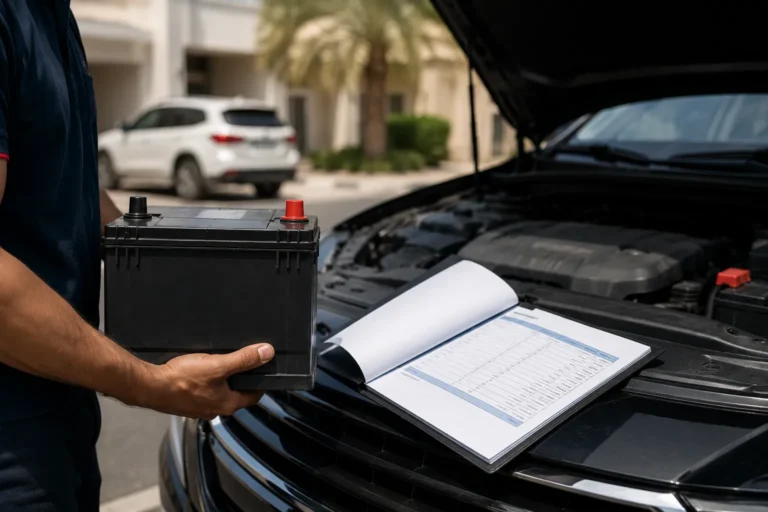
Battery replacement workshops and mobile technicians — a legitimate Dubai provider will remove your old battery and route it through an approved recycler as part of the service. This is the simplest path for almost everyone: the battery never becomes your problem to dispose of, because it’s handled at the point of replacement.
Licensed recycling facilities — Dubai and the surrounding industrial zones have dedicated lead-acid battery recycling plants built specifically for this, processing large volumes and recovering lead and plastics for reuse.
Retailer take-back and exchange programs — some battery brands and auto parts retailers in Dubai offer a discount when you trade in an old battery at purchase, which also routes it through their own compliant disposal chain.
What’s not licensed: informal scrap collectors doing door-to-door pickups in pickup trucks, anyone offering to “take it off your hands” with no paperwork or company name, and definitely never your building’s general waste bin.
Lithium-Ion and EV Batteries Follow Different Rules
If your disposal question is about a hybrid or EV battery rather than a standard 12V lead-acid battery, the rules in Dubai are stricter, not looser. Lithium-ion batteries carry fire and thermal-runaway risk, so you can’t simply drop one at a general recycling point. It has to go through approved specialist channels equipped to handle transport and storage safely — and storing a damaged or end-of-life EV battery at home, in a basement, or in a parking structure isn’t permitted once it’s reached end-of-life. If you’re dealing with a hybrid battery specifically, that’s a call to a specialist, not a DIY drop-off.
How to Dispose of a Car Battery the Right Way in Dubai
If you’re a private car owner, the easiest and most reliable route is to have it handled at the point of replacement. A mobile battery replacement service removes the old unit on the spot and takes disposal off your plate entirely — no separate trip, no researching drop-off points, no risk of it sitting in your garage for six months “until you get around to it” (which, realistically, is how a lot of leaking batteries happen).
If you’re removing it yourself for any reason, a few basics matter: keep it upright to avoid acid spilling from the vent caps, don’t store it anywhere near heat or direct sun while it waits for collection, and never place it loose in a car boot without securing it — a battery sliding around on a Dubai drive to a recycler is exactly the scenario that causes acid leaks.
If you run a fleet or workshop in Dubai, the requirements step up. You’re expected to use a licensed hazardous waste handler, keep records of what’s been collected, and operate under the correct permit category through the Municipality’s waste portal. This isn’t optional at commercial volume — unlicensed disposal at business scale is exactly what the fee and fine structure under Executive Council Resolution No. 58 of 2017 exists to penalize.
What It Costs (and Why “Free” Is Normal)
Here’s the good news: for an individual car owner, proper battery disposal is rarely a separate cost. Because the lead and plastic inside a battery have real resale value to a recycler, most licensed collectors — including replacement technicians — take the old unit for free as part of the service, and some retailers even knock a small amount off a new battery price for the trade-in.
Where cost does come in is at commercial scale: Dubai businesses generating hazardous waste in volume may pay disposal fees under the Municipality’s fee schedule, and getting caught disposing improperly carries fines that are set deliberately higher than the cost of doing it correctly — the incentive structure is designed that way on purpose.
FAQ
Is it actually illegal to throw a car battery in a regular trash bin in Dubai?
Yes. Used car batteries are classified as hazardous waste under Federal Law No. 12 of 2018, and Dubai Municipality’s own regulations require licensed disposal — throwing one in general trash breaches both.
Can I sell my old battery to an informal scrap collector in Dubai?
You can, but you shouldn’t. Informal collectors are exactly the group Dubai Municipality’s Circular No. 3 of 2018 was written to address, because unlicensed handling is how battery acid ends up dumped rather than properly treated. A licensed collector or your replacement technician is the compliant option.
Does the workshop or technician handle disposal automatically when they replace my battery?
With a legitimate Dubai provider, yes — removal and compliant disposal of the old battery is standard practice bundled into a replacement job, so you don’t need to arrange anything separately.
What happens to a recycled car battery?
Up to 99% of the material is recoverable. The lead is reclaimed and reused in new batteries, the plastic casing is reprocessed, and the sulfuric acid is often neutralized or repurposed industrially rather than discarded.
Are EV and hybrid batteries recycled the same way as regular car batteries in Dubai?
No. Lithium-ion and EV batteries require specialist handling due to fire risk and can’t go through general recycling points — they need an approved channel equipped for controlled transport and storage, particularly once the battery is damaged or end-of-life.
Do businesses need a special permit to dispose of batteries in Dubai?
Yes, at commercial volume. Dubai Municipality requires a Waste Disposal Services (WDS) permit for hazardous waste generators, applied for through the Municipality’s waste portal, with fees set under Executive Council Resolution No. 58 of 2017.
The Bottom Line
Battery disposal in Dubai isn’t complicated once you know the actual rule: it’s hazardous waste, it has to move through a licensed handler, and informal scrap collection — however convenient it looks in the moment — is exactly what the law is written to prevent. For most drivers, the simplest way to stay fully compliant without thinking about any of this is to let it be handled at the point of replacement. Book a mobile battery replacement in Dubai and your old battery gets removed and recycled correctly as part of the job, no separate trip required.
Did you know your old battery was classified as hazardous waste before reading this, or did you assume it was just scrap like anything else?