A woman broke down on Emirates Road in August a few years back — nothing dramatic, just a flat tyre — and ended up waiting almost 40 minutes in 46°C heat with no water in the car because she didn’t think she’d need it for “just a quick roadside fix.” That’s the detail most breakdown checklists miss: in Dubai, the car problem is rarely the dangerous part. The heat while you’re dealing with it is.
A proper Dubai emergency car kit needs four categories covered — a legally required warning device, heat and hydration safety, visibility and communication tools, and basic tyre/jump-start equipment. Most drivers have one or two of these. Almost nobody has all four, and the gap is usually the heat-safety category, which matters more here than anywhere with a milder climate.
What’s Actually Legally Required
Start with the one item that isn’t optional. Since September 2009, a reflective warning triangle has been a mandatory requirement for vehicle registration in Dubai — Tasjeel and Shamil inspection centres will fail your renewal without one in the car. If your vehicle stalls or you need to pull over, RTA guidance is to place it roughly 50 metres behind your vehicle, in the direction traffic is coming from, so drivers get enough warning to react. It’s a small plastic triangle, costs around AED 30, and it’s one of the few genuinely life-saving items on this whole list — Dubai Police have specifically flagged failing to display one as a factor in roadside fatalities involving stopped vehicles on highways.
If you don’t already have one in the car, this is the single highest-priority item to fix today, before anything else on this list.
The Heat-Safety Items Most Checklists Skip
Generic breakdown checklists are written for climates where the biggest risk while you wait is boredom. In Dubai, the biggest risk is your own body overheating while you troubleshoot a problem outside in direct sun.
Water — more than you think you need. Not a single bottle “just in case.” Keep at least 2-3 litres in the car permanently, ideally in an insulated container so it doesn’t turn undrinkably hot by July. This matters most for exactly the scenario where you’d normally forget it: a short trip that turns into a 30-minute wait.
Sun protection you can actually use standing outside. A wide-brim hat or cap, and if you have room, a small foldable sunshade or umbrella. Waiting for help under direct midday sun for even 15 minutes in peak summer is a genuine heat-exhaustion risk, not just discomfort.
A phone power bank, charged and left in the car. Your phone is your lifeline for calling for help, and it’s also the thing burning battery fastest from screen brightness and heat-throttled performance on a stalled dashboard. A dead phone during a breakdown turns a minor inconvenience into a real problem.
Visibility, Tools, and Communication
Beyond the mandatory triangle, a few more items make you genuinely easier to help and safer while you wait.
A high-visibility vest. Not required by law the way the triangle is, but standing on a hard shoulder in regular clothes at night — or even during Dubai’s frequent low-visibility dust conditions — is far riskier than most drivers assume.
A basic tool kit and tyre inflator. A 12V compact tyre inflator that plugs into your car’s socket can resolve a slow puncture well enough to get you to a safer spot or a workshop, without needing a full tyre change on a live hard shoulder.
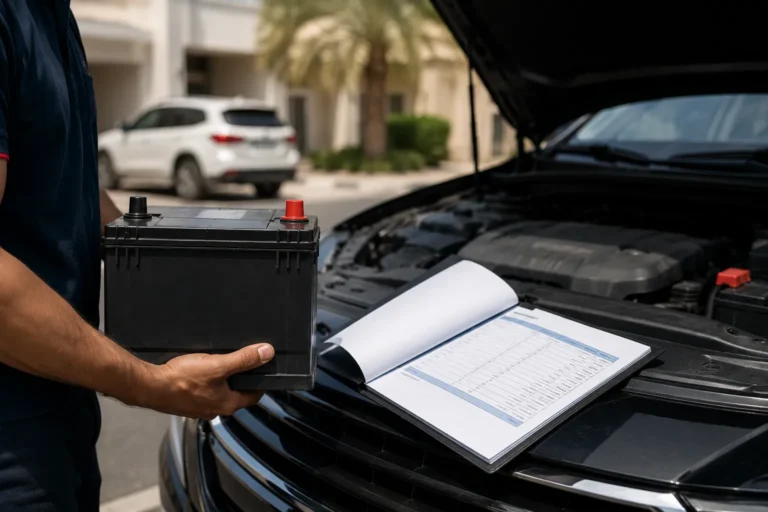
Jumper cables or a portable jump-starter pack. A dead battery is the single most common roadside call in Dubai, and a portable jump-starter (the small brick-sized units, not full cables requiring a second car) means you’re not dependent on another driver stopping to help you.
A basic first aid kit. Standard advice anywhere, but worth restating — cuts and scrapes from roadside repairs happen more than people expect.
The Full Kit at a Glance
| Item | Why It Matters in Dubai | Approx. Cost |
|---|---|---|
| Reflective warning triangle | Legally required for registration; direct safety factor on highways | AED 30 |
| 2-3L water (insulated) | Prevents heat exhaustion while waiting outside | AED 15-25 |
| Sun hat / foldable sunshade | Reduces direct heat exposure during outdoor waits | AED 30-60 |
| Phone power bank | Keeps your only communication lifeline alive | AED 60-120 |
| High-visibility vest | Makes you visible to traffic and to help arriving | AED 20-40 |
| 12V tyre inflator | Handles slow punctures without a full roadside tyre change | AED 80-150 |
| Portable jump-starter | Removes dependence on a second car for a dead battery | AED 150-300 |
| Basic first aid kit | Covers minor injuries from roadside repairs | AED 30-50 |
Total cost to assemble the full kit sits somewhere around AED 400-750 depending on quality — a one-time cost that covers you for years, versus one bad wait on a hard shoulder in July.
What to Actually Do When You Break Down in Dubai
Having the kit only helps if you use it in the right order. If your car stalls or you notice a problem, get off the live lane and onto the hard shoulder or a safe area first — don’t stop to assess the problem in traffic. Turn on hazard lights immediately, then place the warning triangle roughly 50 metres back. Only after those two steps should you get out to check the car, and even then, stay on the side away from traffic.
If it’s midday heat, sit back inside the car with windows cracked rather than standing outside the whole time you wait — the interior, even without AC running, generally beats standing in direct sun. Drink water regularly rather than saving it “in case it gets worse.”
And if the fix isn’t something your kit can handle — a battery that won’t take a jump, a tyre that’s shredded rather than slow-leaking, or anything electrical — that’s the point to call for help rather than keep troubleshooting in the heat.
FAQ
Is the warning triangle really mandatory, or just recommended?
It’s mandatory. It’s been a required vehicle registration item at Dubai’s Tasjeel and Shamil centres since September 2009, and vehicles without one fail the registration safety check.
How much water should I realistically keep in the car?
At least 2-3 litres, kept permanently in the car rather than “topped up when I remember.” Insulated bottles or a small cooler bag help keep it drinkable through summer heat rather than undrinkably hot.
Are jumper cables or a portable jump-starter better for Dubai?
A portable jump-starter is generally more practical here, since it doesn’t require flagging down a second car and waiting for someone willing to stop on a busy road.
What’s the single most important item if I can only buy one thing today?
The reflective warning triangle, both because it’s legally required and because it’s the item most directly linked to preventing roadside accidents involving stopped vehicles.
Should I attempt a tyre change myself on a busy Dubai road?
Only if you’re safely off the live lanes with the triangle placed. On a fast-moving highway hard shoulder, it’s often safer to use a tyre inflator for a temporary fix and get somewhere safer, or call for assistance, rather than crouch beside live traffic changing a wheel.
Does having an emergency kit mean I don’t need roadside assistance?
No — think of the kit as what gets you through the first 10-15 minutes safely, not a replacement for a proper fix. A flat tyre inflator buys you time; it doesn’t repair a shredded tyre or a battery that won’t hold charge.
The Bottom Line
A good emergency kit in Dubai isn’t about being self-sufficient forever — it’s about staying safe and comfortable for the time it takes help to arrive. Between the legally required triangle, enough water to actually last a hot wait, and a way to keep your phone alive, you’ve covered the parts a breakdown checklist written for a cooler climate would never think to mention. For everything past what a kit can fix — a battery that won’t take a jump, a tyre that’s actually damaged, or anything you’re not confident handling roadside — QuickHelp brings help straight to your location anywhere in Dubai, typically arriving in 25-30 minutes, with a free battery test included on every callout.
What’s actually in your car right now — and be honest, is the warning triangle one of them?