A customer came to us last winter with a brand-new Land Cruiser, fitted with the highway tyres it came with from the dealer, asking why it kept losing traction the moment he hit soft sand near Al Qudra. The tyres weren’t faulty — they were doing exactly what highway tyres are built to do, which is grip tarmac, not sand. He’d bought the right vehicle for desert weekends and put the wrong tyre on it.
For Dubai’s mix of daily city driving and occasional desert trips, all-terrain (A/T) tyres are the right default for most drivers — highway tyres if you never leave paved roads, and off-road/mud-terrain tyres only if you’re seriously off-roading on a regular basis, not just doing the occasional Al Qudra or Hatta run. The tread pattern and sidewall construction that make a tyre good in sand are close to the opposite of what makes it quiet and fuel-efficient on Sheikh Zayed Road, so the “best” tyre genuinely depends on how much of each kind of driving you actually do.
Highway Tyres: Built for Tarmac, Not Sand
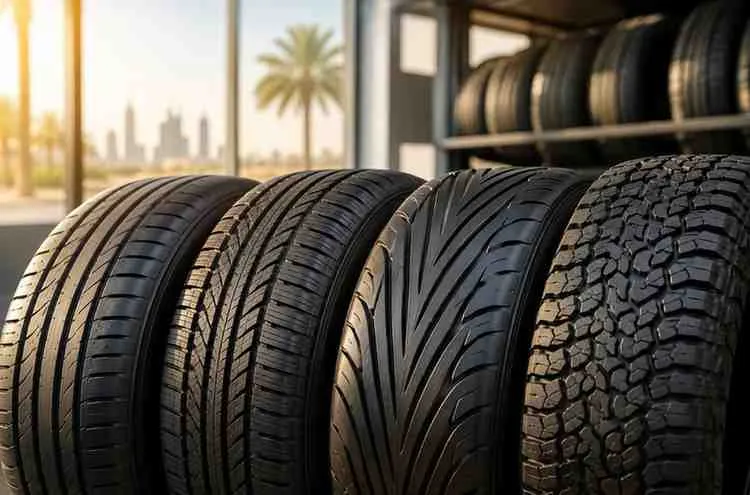
Highway (H/T) tyres are what most sedans and a lot of SUVs come fitted with from the factory. The tread pattern uses tighter, more continuous grooves designed to channel water and maintain contact with a smooth road surface — which is exactly what you want for daily Dubai commuting, but the opposite of what sand needs.
On loose sand, a highway tyre’s tighter tread pattern packs with sand almost immediately and loses traction, which is why cars with highway tyres get stuck so easily off the paved road. The sidewalls are also built lighter, prioritizing comfort and fuel efficiency over resistance to punctures from rocks or sharp debris — fine for city streets, less fine for gravel tracks or unpaved shortcuts.
Best for: drivers who genuinely never leave paved roads — city commuting only, no desert trips, no gravel driveways or construction-adjacent routes.
All-Terrain Tyres: The Practical Dubai Default
All-terrain (A/T) tyres split the difference, and for most Dubai drivers with an SUV or 4×4, this is the tyre that actually matches real driving patterns — city during the week, the occasional desert or mountain trip on weekends.
The tread blocks are larger and more open than a highway tyre’s, giving enough bite in sand and gravel to avoid getting stuck on a casual desert drive, while still being tight enough to handle wet and dry tarmac reasonably well. Sidewalls are reinforced compared to highway tyres, offering real resistance to punctures from rocks, curbs, and rough unpaved tracks — a genuine advantage if you’re driving through construction zones or newer developments with unfinished roads, which describes a lot of Dubai.
The trade-off is modest: slightly more road noise than a pure highway tyre, marginally higher fuel consumption, and tread wear that’s a touch faster on pure tarmac use. For the vast majority of SUV owners who do a few desert trips a year but mostly drive on paved roads, that trade-off is easily worth it.
Best for: SUV and 4×4 owners who mix daily city driving with occasional desert trips, camping, or driving through less-finished roads.
Off-Road / Mud-Terrain Tyres: Built for Serious Off-Roading
Mud-terrain (M/T) tyres go further — large, aggressive, widely spaced tread blocks designed to dig into sand, mud, or rock rather than glide over it, paired with the most reinforced sidewalls of the three types. If you’re doing serious dune bashing, rock crawling, or regular off-road routes where getting stuck or damaging a sidewall is a real risk, this is the category built for it.
The cost of that capability shows up the moment you’re back on tarmac. Mud-terrain tyres are noticeably louder on the highway, wear unevenly and faster on pavement, and use noticeably more fuel due to higher rolling resistance from the aggressive tread pattern. Most daily drivers who put mud-terrain tyres on a vehicle they mostly use in the city end up regretting it within a few months, once the novelty of the aggressive look wears off and the highway noise doesn’t.
Best for: drivers doing regular, serious off-roading — not the occasional weekend drive, but frequent dune or rock terrain — where an all-terrain tyre’s capability genuinely isn’t enough.
Comparing the Three
| Factor | Highway (H/T) | All-Terrain (A/T) | Off-Road / Mud (M/T) |
|---|---|---|---|
| Sand/desert traction | Poor — packs with sand quickly | Good — handles casual desert driving well | Excellent — built for serious off-road use |
| Highway noise | Quietest | Moderate | Loudest |
| Fuel efficiency | Best | Slightly reduced | Noticeably reduced |
| Sidewall/puncture resistance | Lowest | Reinforced, good for rough tracks | Highest |
| Tarmac tread life | Longest | Good | Wears faster on pavement |
| Relative price tier | Lowest | Mid-range | Highest |
| Ideal driver | City-only commuters | Mixed city + occasional desert (most SUV owners) | Frequent, serious off-roaders |
If you’re unsure which row describes you, the honest test is frequency, not ambition. Owning a 4×4 “in case” you go off-road doesn’t need mud-terrain tyres — actually going off-road most weekends does.
What Tyre Choice Means for Puncture Risk
Tyre type doesn’t just affect grip and noise — it directly affects how often you’ll be dealing with a puncture. A highway tyre’s lighter sidewall construction makes it more vulnerable to cuts and punctures if you regularly drive on gravel, unfinished roads, or construction-adjacent routes, even without ever going properly off-road. All-terrain and mud-terrain tyres reduce that risk with reinforced sidewalls, but no tyre is puncture-proof — a sharp rock or a bad curb strike can still get through even the toughest off-road tyre.
Whatever type you’re running, a slow leak or sudden puncture is still going to happen eventually, and getting it looked at quickly matters more than which tyre category caused it. If that happens, same-day tyre puncture repair in Dubai gets you back on the road without needing to track down a workshop yourself.
What This Means for Your Next Tyre Purchase
Once you know which category fits your actual driving pattern, the decision narrows fast — it’s really about matching that category to your vehicle’s size and your budget tier within it. All-terrain tyres in particular span a wide price range depending on brand and load rating, so it’s worth comparing specific options against your exact tyre size rather than shopping by category alone. You can browse our full tyre range to see what’s available for your vehicle and get fitted with the right type for how you actually drive, not just what looks right on the vehicle.
FAQ
Can I put all-terrain tyres on a car that never goes off-road?
Yes, but there’s little benefit — you’d be accepting more road noise and slightly worse fuel economy for capability you’re not using. All-terrain tyres make sense once you’re actually driving on sand or gravel occasionally, not as a precaution.
Will off-road tyres damage my car if I mostly drive in the city?
Not damage exactly, but they wear faster on tarmac, cost more in fuel, and are noticeably louder — daily city use isn’t what they’re optimized for, so most drivers find the trade-off isn’t worth it unless they’re genuinely off-roading often.
Do all-terrain tyres reduce fuel efficiency noticeably?
Slightly — typically a small, often unnoticeable difference for most drivers compared to highway tyres, and far less of a penalty than mud-terrain tyres carry.
How do I know if I’m driving enough off-road to justify all-terrain over highway tyres?
If you take unpaved roads, sandy tracks, or gravel routes even occasionally — weekend desert trips, camping, driving through newer developments with unfinished roads — all-terrain is worth it. If you strictly stay on paved roads, highway tyres remain the better fit.
Are mud-terrain tyres legal and safe for daily Dubai roads?
Yes, they’re legal and safe on paved roads — they’re just not optimized for it. The trade-offs are comfort, noise, and fuel economy, not legality or safety.
Does tyre type affect how quickly I get a flat in Dubai’s heat?
Not directly from heat itself, but a lighter-sidewall highway tyre is more vulnerable to punctures from rocks or debris on rougher routes, while reinforced all-terrain and mud-terrain sidewalls hold up better against that specific risk.
The Bottom Line
The tyre that’s “best” for Dubai isn’t one tyre — it’s whichever of the three actually matches how you drive, not how your vehicle looks. Most SUV and 4×4 owners doing normal Dubai life plus the occasional desert trip land squarely in all-terrain territory; pure city commuters are usually better off with highway tyres; and mud-terrain tyres earn their keep only with genuinely frequent off-road use. Whatever you’re running now, if it’s picking up more punctures than it should for how you actually drive, that’s usually the tyre telling you it’s the wrong type for your routine, not just bad luck.
How much of your driving is actually desert or gravel versus city — more or less than you assumed before reading this?