You’re doing 60 km/h on Sheikh Zayed Road, boxed in by trucks, when you glance down and the temperature needle has crept past the halfway mark and is climbing. Steam might already be curling out from under the hood. There’s nowhere obvious to pull over, the AC is blasting to keep you sane in the heat, and every YouTube video you half-remember about “what to do when your car overheats” is now competing for space in your head with the truck horn behind you.
Here’s the problem with most overheating advice online: it’s written for a driveway, not for a highway shoulder in Dubai’s 45°C summer heat with traffic still moving past you at speed. What you actually do in that first 60 seconds matters more than any explanation of how a cooling system works — get it wrong, and a fixable coolant top-up turns into a cracked head gasket and a AED 4,000+ repair bill.
This guide gives you the exact sequence: what to do the moment you see that needle rise, what never to touch, and how to tell whether you’re looking at a five-minute fix or a tow truck situation.
Quick answer: The moment you see the temperature gauge climbing, turn off the AC, turn the heater on full blast, and get to a safe stop as soon as you reasonably can — don’t push on “just a bit further.” Once stopped, turn the engine off and let it sit for at least 30 minutes before touching anything under the hood. Never open the radiator cap while the engine is hot. If steam is heavy, coolant is visibly leaking, or a warning light is flashing rather than steady, don’t attempt to restart — call for help.
The First 60 Seconds: What to Actually Do
This is the sequence, in order, the moment you notice the gauge climbing or a warning light appears:
- Turn off the air conditioning immediately. The AC compressor puts additional load on the engine and competes with the cooling system for capacity. This is the single fastest thing you can do to reduce heat load, and it costs you nothing.
- Turn the heater on full blast, even in peak Dubai summer heat. This sounds insane, and every passenger will complain, but it works — the heater core pulls hot coolant away from the engine and dumps that heat into the cabin instead of letting it build up under the hood. It’s an ugly ten minutes, but it genuinely buys you time and reduces strain on the system.
- Get to a safe stop as soon as reasonably possible. Not the hard shoulder of a fast-moving highway if you can help it — the next exit, a petrol station, a side street off Al Khail Road or wherever you happen to be. But don’t chase the “perfect” stopping spot for five extra minutes while the engine keeps cooking. A slightly less ideal spot reached in 90 seconds beats a great spot reached in five minutes with a blown head gasket.
- Turn the engine off once stopped. Running a genuinely overheating engine, even at idle, keeps generating heat the cooling system already can’t handle.
- Pop the hood — but don’t touch anything yet. This lets heat escape and gives you a first visual read on what’s happening: steam, obvious leaks, a slipped belt.
- Wait. At least 30 minutes, ideally longer. This is the step almost everyone rushes, and it’s the one that causes injuries and worse damage.
What You Must Never Do
Never open the radiator cap on a hot engine. The cooling system is pressurized specifically so coolant can run hotter than its normal boiling point without boiling. Crack that cap while it’s hot and pressurized, and you’re releasing what is effectively a geyser of near-boiling coolant straight upward — this causes serious burns every single year, and it’s completely avoidable by just waiting.
Never pour cold water directly onto a hot engine block or radiator. The thermal shock from that temperature difference can crack an engine block or warp a cylinder head — turning a coolant problem into a catastrophic, car-ending one. If you’re genuinely stuck and need to add fluid once things have cooled, add it slowly, with the engine off, and only after the temperature gauge has actually come back down.
Never keep driving “because you’re almost there.” This is the single most expensive mistake we see. An engine that’s overheating and still being driven is actively damaging itself with every additional kilometer — head gaskets warp, cylinder heads crack, and what would have been a AED 150 coolant top-up becomes a AED 4,000+ engine repair. If the gauge is in the red, “almost there” isn’t close enough — not even those last two kilometers to Business Bay or DIFC.
Why This Happens So Often on Dubai’s Roads
Everyone blames the heat, and heat is obviously part of it — but the specific pattern in Dubai is stop-and-go traffic combined with already-hot ambient air. A cooling system is designed to shed heat into the surrounding air as the car moves; airflow through the radiator is a huge part of how it works. Sit in traffic on Sheikh Zayed Road at 2 PM in July, moving at 10 km/h with minimal airflow, ambient temperature already north of 45°C, and AC compressor working overtime — the system is fighting a losing battle even if every component under the hood is in perfect condition. Add a coolant level that’s even slightly low, a thermostat that’s starting to stick, or a radiator with a few years of dust and grime built up, and you tip over the edge.
This is also why overheating in Dubai often isn’t a sign of a badly neglected car — it can happen to well-maintained vehicles simply because the margin for error shrinks so much when extreme heat and heavy commuter traffic combine, whether you’re crawling through Al Khail Road at rush hour or stuck on Business Bay Crossing.
Common Causes, Ranked by How Often We See Them
- Low coolant level — the most common cause by far, usually from a slow leak nobody’s noticed yet, or simply not being checked in months.
- Failing thermostat — stuck closed, it blocks coolant flow to the radiator entirely; this often shows up as a sudden spike rather than a gradual climb.
- Leaking hose or radiator — visible drips under the car, often before or after driving, or a sweet smell (that’s the coolant itself).
- Failing water pump — coolant simply isn’t circulating properly; sometimes accompanied by a whining noise from the front of the engine.
- Slipped or broken serpentine belt — this one often comes with a squealing noise and, on many cars, a total loss of power steering at the same time as the overheating.
- Radiator blocked by dust and debris — more common in Dubai than most drivers assume, from constant exposure to fine sand and dust reducing airflow through the radiator fins.
Quick Fix or Tow Truck? How to Tell
| Sign | Likely quick fix | Likely needs a tow |
|---|---|---|
| Gauge rising, no steam, no smell | Yes — often just low coolant | — |
| Light steam, no coolant visible under car | Possibly | Get it checked before driving further |
| Heavy steam or coolant actively spraying | — | Yes, don’t attempt to drive |
| Sweet smell but no visible leak | Possibly a slow leak | Worth a proper check before it worsens |
| Warning light steady | Monitor closely | — |
| Warning light flashing | — | Yes, stop immediately |
| Squealing noise + loss of power steering | — | Yes, likely a belt issue |
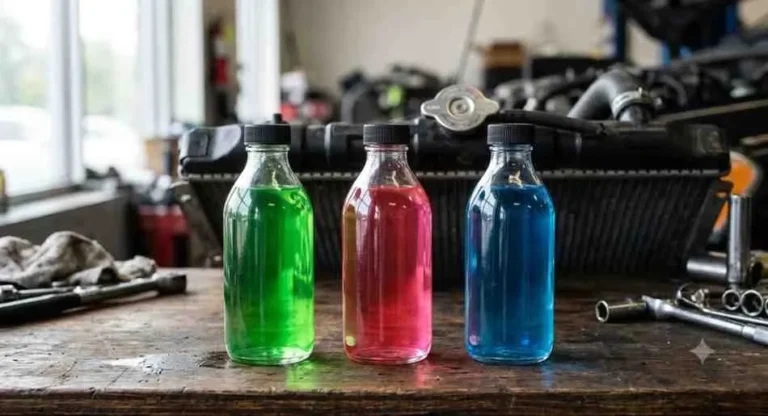
| Coolant is brown, rusty, or has debris in it | — | Needs a proper flush, not just a top-up |
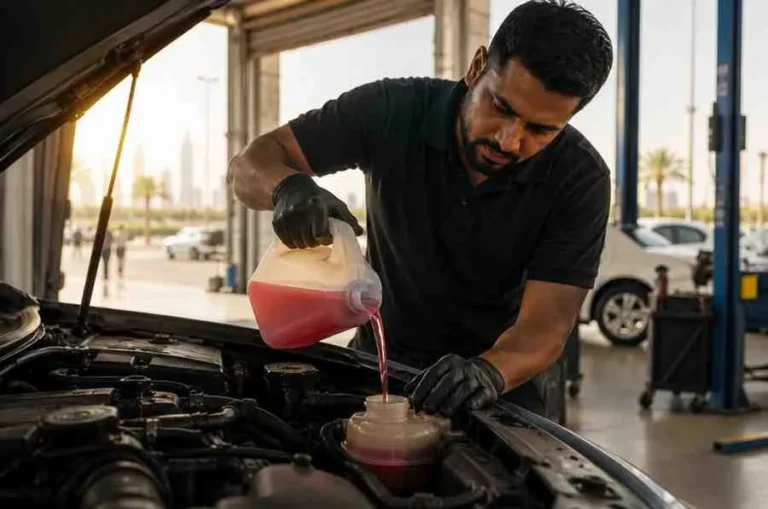
If you land in the “quick fix” column and coolant is simply low with no signs of an active leak, a mobile top-up gets you back on the road properly rather than limping to the nearest workshop and hoping. We handle this across Dubai — you can see how the visit works for coolant top-up in Dubai, including checking for the underlying cause rather than just refilling and sending you on your way.
What It Costs to Fix in Dubai
These are general ranges — your exact cost depends on the make, model, and root cause, so treat this as a starting point rather than a quote.
- Simple coolant top-up (no leak found): Often under AED 150–250 for the visit and fluid.
- Coolant flush and refill: Roughly AED 200–400 depending on vehicle size and coolant type required.
- Hose replacement: AED 150–500 depending on which hose and vehicle model.
- Thermostat replacement: AED 250–700 including labor.
- Water pump replacement: AED 500–1,500, more on some European models.
- Head gasket repair (from prolonged overheating): AED 2,500–6,000+ — this is the outcome you’re avoiding by stopping early and letting the engine cool properly.
That gap between a coolant top-up and a head gasket repair is the entire reason the first 60 seconds matter more than anything else in this guide.
Frequently Asked Questions
Is it safe to keep driving once the gauge comes back down?
Not without getting it checked first. The gauge returning to normal after you’ve stopped and cooled the engine doesn’t mean the underlying cause is fixed — it usually just means the immediate crisis has passed. Driving on assuming it’s resolved is how a AED 150 problem becomes a AED 4,000 one.
Can I use plain water instead of coolant in an emergency?
Only as a genuine last resort to limp to help, and only once the engine has cooled. Plain water lacks the corrosion inhibitors and the higher boiling point coolant provides, and in Dubai’s heat specifically, water alone boils far more easily than a proper coolant mix. Get it replaced with real coolant as soon as possible.
How long should I actually wait before opening the hood?
A minimum of 30 minutes for the engine to cool enough to be safe. If you’re unsure, the reservoir cap (not the radiator cap) can sometimes be checked sooner, but when in doubt, wait longer rather than less.
Why does my car overheat only in traffic, not on the highway?
This is a classic sign of reduced airflow through the radiator combined with heavier AC load — highway speed pushes air through the radiator efficiently, while crawling through Dubai traffic doesn’t. It often points to a radiator fan issue or a system that’s already running close to its limit.
Does topping up coolant fix a leak?
No — it fixes the symptom, not the cause. If you’re topping up regularly, there’s a leak somewhere that needs to be found and repaired, or you’ll end up stranded again, possibly somewhere less convenient.
Can low oil cause overheating too?
Indirectly, yes — oil helps manage friction-generated heat inside the engine, so very low oil can contribute to overheating even with a fully functional cooling system. Worth checking both at the same time.
Is overheating worse for turbocharged engines?
Generally yes — turbocharged engines run hotter under load to begin with, so they have less margin for error when the cooling system is compromised.
What’s the very first thing I should do if I see steam but I’m still moving?
Turn off the AC, turn the heater on, and get to a safe stop as described above — don’t wait to see if it gets worse. Steam while driving means the system is already struggling.
The Bottom Line
An overheating engine is one of the few roadside situations where doing nothing for the first minute is actually the wrong move, and doing the wrong thing for the next five minutes is how you turn an inconvenience into a real repair bill. Turn off the AC, turn on the heater, get to a safe stop, and give it real time to cool before you touch anything. That sequence alone prevents the majority of the expensive outcomes we see on Dubai’s roads.
If your temperature gauge has been creeping up more than once, or you’re topping up coolant regularly, that’s not something to keep managing on your own — get it checked properly before it happens again somewhere far less convenient than today.