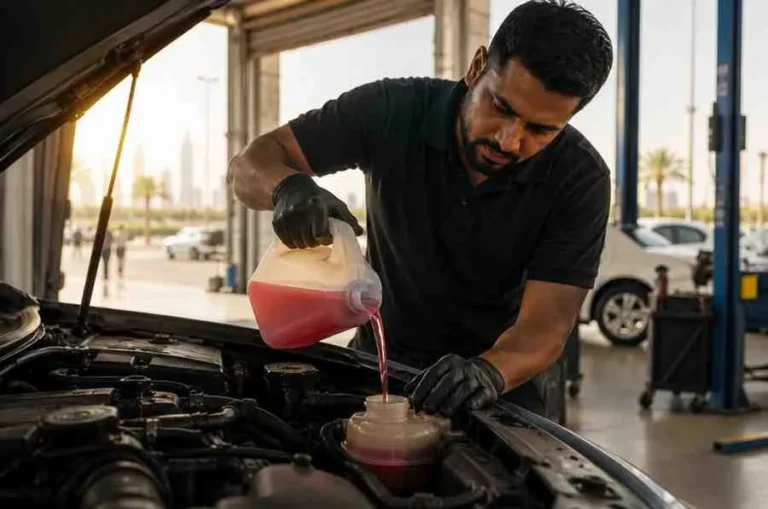
You pop the hood to top up your coolant, and the reservoir is a color you don’t recognize. Green? Red? Somewhere in between? Here’s the part almost nobody tells you clearly: grabbing “whatever coolant is on the shelf” because it looks close enough is one of the more common, and more expensive, mistakes car owners make, especially in a climate like Dubai’s where the cooling system has zero margin for error.
This guide breaks down what coolant colors actually mean, which one your car needs, and why mixing the wrong two can turn a AED 150 top up into a much bigger repair bill.
Does Coolant Color Actually Matter?
Coolant color itself doesn’t determine performance, but it’s historically been used to indicate the coolant’s chemical technology, and mixing two different technologies, regardless of color, can create a sludge that clogs your cooling system and reduces its ability to transfer heat. In Dubai’s climate, where the cooling system is already working harder than in milder countries, that’s a risk worth taking seriously.
What Do the Different Coolant Colors Mean?
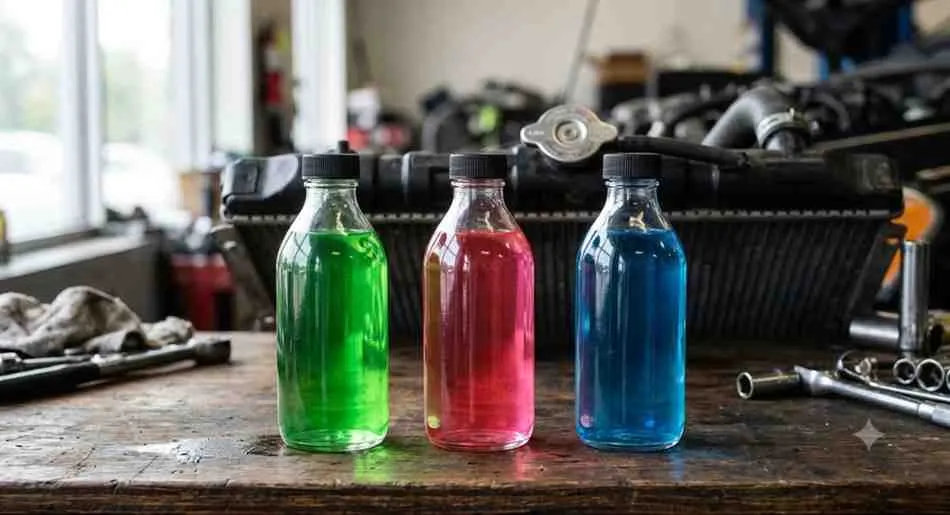
| Color | Common Technology | Typically Found In | Change Interval |
|---|---|---|---|
| Green | IAT (Inorganic Additive Technology) | Older vehicles, some Asian models | Every 2 years |
| Red / Pink | OAT (Organic Acid Technology) | Many Asian and some European vehicles | Up to 5 years |
| Orange | OAT / Extended Life Coolant | Some GM and American models | Up to 5 years |
| Blue | Varies — IAT or HOAT depending on manufacturer | European vehicles, some hybrids | 2–5 years |
| Yellow | HOAT (Hybrid Organic Acid Technology) | Ford, Chrysler, some European brands | Up to 5 years |
The important catch: color is no longer a reliable universal code. Two different manufacturers can both use blue coolant for entirely different chemical formulations. The only way to know for certain what your car needs is to check the owner’s manual or the cap on the coolant reservoir itself, not the color of what’s already inside.
Why Is Mixing Coolant Colors Risky?
Mixing incompatible coolant technologies, for example, older green IAT coolant with orange OAT coolant, can cause a chemical reaction that forms a thick sludge inside the cooling system. That sludge clogs the radiator, thermostat, and water pump, which reduces the system’s ability to move heat away from the engine. In Dubai’s summer heat, a cooling system that’s already compromised by sludge has far less capacity to handle the extra thermal load, which meaningfully raises the risk of overheating.
The safe rule: if you don’t know what’s currently in your system, don’t guess based on color. Either confirm the coolant type from your manual, or use a universal/pre-mixed coolant specifically labeled as compatible with multiple technologies.
Can I Switch From One Coolant Color to Another?
Yes, but only with a full system flush, not a simple top up. Draining the radiator alone typically leaves 10-20% of the old coolant trapped in the engine block and heater core, which mixes with the new coolant regardless of how carefully you drain it. A proper flush clears the system fully before refilling with the new type, avoiding the sludge risk entirely.
What Coolant Does My Car Actually Need?
Rather than relying on color, check these three sources, in order of reliability:
- The cap on your coolant reservoir — many manufacturers print the recommended coolant type directly on or near the cap.
- Your owner’s manual — lists the exact coolant specification (often an OEM part number or technology type like OAT, HOAT, or IAT).
- A workshop check — if you’re unsure and don’t have the manual handy, a technician can identify the current coolant and recommend a compatible option before any top up.
If none of these are available and you need an emergency top up, a universal coolant explicitly labeled safe for mixed systems is the lowest-risk choice, though it’s still worth confirming your exact coolant type before your next scheduled top up.
Premixed vs. Concentrate: Which Should You Use?
Premixed coolant comes ready at the manufacturer’s recommended ratio (typically 50/50 coolant to distilled water) and removes the guesswork entirely, which is the safer choice for most drivers doing their own top up. Concentrate requires you to mix it correctly with distilled water yourself, and an incorrect ratio, too much water lowers the boiling point protection, too little reduces heat transfer, can undermine the coolant’s effectiveness even if the color and type are otherwise correct.
For Dubai’s climate specifically: premixed coolant is generally the more reliable choice for anyone topping up their own car, since getting the ratio wrong in extreme heat has less margin for error than in milder climates.
Frequently Asked Questions
Is green coolant always the wrong choice for a newer car? Not necessarily, some newer vehicles still specify IAT-style coolants, but it’s less common. The safest approach is always confirming against your specific manufacturer’s recommendation rather than assuming green is outdated across the board.
What color coolant do most European cars use in the UAE? Blue and yellow are common in European vehicles, but formulations vary meaningfully by manufacturer, so the color alone shouldn’t be treated as a reliable guide even within this category.
I accidentally mixed two coolant colors, what should I do? Avoid driving the vehicle for extended distances and have the cooling system inspected and flushed as soon as possible, since continuing to drive on a compromised mix increases the risk of clogging and overheating.
Does coolant color fade or change naturally over time? Yes, coolant can gradually darken with age and heat exposure even without contamination. However, a coolant that’s turned rusty brown or has visible particles suggests corrosion or contamination, and should be flushed rather than topped up.
Is it safe to use a “universal” coolant for any car? Universal coolants explicitly labeled as compatible across technologies are generally safe for mixed systems and emergency top ups, but checking your manufacturer’s specific recommendation is still the more precise long-term choice.
The Bottom Line on Coolant Colors
Color is a clue, not a rulebook. What actually protects your engine is matching the coolant’s chemical technology to what your manufacturer specifies, not matching the shade in the bottle to what’s already in your reservoir. When in doubt, a quick check before topping up costs you nothing. Guessing wrong can cost considerably more.
Not sure what’s currently in your system? QuickHelp can check and top up the right coolant for your car, starting from AED 150, across Dubai and Sharjah. See our full range of services for anything else your car needs.
Need Help With Your Car Right Now?
25-minute average response time. Available 24/7 across Dubai, Sharjah, and Ajman.
Help is minutes away, wherever you are.