It’s 7:42 AM on Sheikh Zayed Road. You turn the key — or press the start button — and nothing happens. Or maybe something happens: a single click, a slow groan, dashboard lights that flicker and die. Whatever the sound is, you now have a decision to make with an audience of honking cars behind you: is this a battery problem, a starter problem, or an alternator problem?
Most drivers assume “car won’t start” always means “dead battery.” It doesn’t. We’ve turned up to jobs across Dubai and Sharjah where the customer was convinced they needed a new battery, only for a two-minute check to show a failing starter motor or a dying alternator instead. Guessing wrong here doesn’t just waste money — it can leave you stranded twice: once today, and again a week later when the real problem finally gives out completely.
This guide walks you through exactly how to tell the difference, what each failure actually sounds and feels like, and what it typically costs to fix in the UAE. No guesswork, no jargon you need a mechanic to translate.
Quick answer: If you hear a rapid clicking sound or the engine cranks slowly before starting, it’s almost always the battery. If you get a single loud click or silence with no cranking at all, suspect the starter motor. If the car started fine but died while driving, or the dashboard battery light came on with the engine running, that points to the alternator. A simple headlight test can confirm which one in under a minute.
The Battery: Slow Crank, Clicking, and Dimming Lights
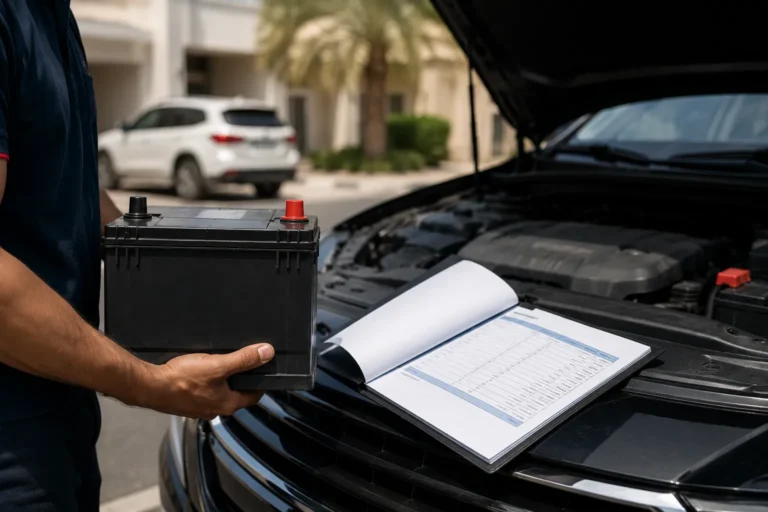
The battery is responsible for one job above all others: delivering a big burst of current to the starter motor so the engine can turn over. When it’s weak, that burst either arrives slowly or doesn’t arrive at all.
What a dying battery sounds like:
- A rapid, machine-gun style clicking when you turn the key
- The engine cranks, but slower than usual — like it’s tired
- Dashboard lights dim noticeably or flicker when you try to start
- The car starts fine after a jump but dies again the next morning
What causes it in the UAE specifically: Heat is the obvious culprit everyone talks about, but the less-discussed factor is short-trip driving. A lot of Dubai and Sharjah commutes are 10–15 minutes — just enough to get you to the office, not enough for the alternator to fully recharge what the starter and AC pulled out that morning. Do that daily for a few months and even a healthy battery ends up chronically undercharged, which accelerates the exact internal degradation that heat causes anyway. It’s a compounding problem, not just a weather problem.
The at-home test: Turn on your headlights before attempting to start the car. If they’re bright and steady, then dim heavily or go out completely the moment you turn the key, that’s a strong battery signal — the battery physically can’t supply enough current for both jobs at once.
If this matches what you’re experiencing, our teams handle mobile battery testing and replacement across both emirates — you can see how it works for battery replacement in Sharjah or battery replacement in Dubai, including same-day home or office visits.
The Starter Motor: One Click, Then Silence
The starter motor is a small but powerful electric motor that physically spins your engine to get it running. When it fails, the symptom pattern is completely different from a battery issue, and this is where a lot of drivers misdiagnose the problem.
What a failing starter sounds like:
- A single loud click, then nothing — no cranking at all
- A whirring or grinding sound, but the engine doesn’t turn over
- Sometimes nothing happens at all — total silence when you turn the key
- Occasionally it starts fine, then randomly won’t the next time (a classic intermittent starter symptom)
The tell-tale difference from a battery problem: your headlights and dashboard stay perfectly bright and normal when you turn the key. That’s the giveaway. If the electrical system clearly has power — lights are strong, radio works, dashboard is lit — but the engine simply won’t crank, the battery is doing its job. The starter isn’t.
We’ve had customers describe this as “the car feels dead” when actually everything electrical is alive; it’s purely a mechanical failure to turn the engine over. Worth noting: an old trick of tapping the starter motor with a wrench to get one more start out of it does sometimes work as a temporary measure, but it’s a sign the starter is on its way out, not a fix.
The Alternator: Fine at Start, Dead on the Road
This is the one that catches people off guard, because the car starts perfectly normally. The alternator’s job isn’t to start the engine — it’s to keep the battery charged and power the electrical system once the engine is running. When it fails, the car runs fine for a while on whatever charge is left in the battery, then dies.
What a failing alternator looks like:
- The car starts fine but stalls or dies while you’re driving
- A battery-shaped warning light illuminates on the dashboard while the engine is running
- Headlights dim while driving, especially noticeable at idle or in traffic
- Electrical accessories (AC blower, radio, power windows) act sluggish or glitchy while the car is on
- A burning rubber smell sometimes, from a slipping alternator belt
Why this gets misdiagnosed constantly: a failing alternator eventually kills the battery too, because the battery is discharging faster than it can recharge. So by the time the car finally won’t start at all, the symptoms look exactly like a dead battery — clicking, slow crank, the works. If you replace the battery at that point without checking the alternator, you’ll be back to a dead car within days, because the new battery gets drained the same way the old one did.
This is the single most expensive mistake we see: paying for a battery replacement when the alternator was the actual root cause the whole time.
Battery vs. Starter vs. Alternator: Side-by-Side Comparison
| Symptom | Battery | Starter | Alternator |
|---|---|---|---|
| Clicking sound when starting | Rapid, repeated clicking | Single, loud click | Not typical |
| Engine cranks | Slowly, or not at all | Doesn’t crank at all | Cranks and starts normally |
| Dashboard lights during attempt | Dim or flicker | Stay bright and normal | Normal at start, dim while driving |
| Car dies while driving | Rare | Never (already running) | Common |
| Warning light on dash | Sometimes, before failure | No | Battery-shaped light, engine running |
| Jump-start fixes it temporarily | Yes | No effect | Yes, but recurs quickly |
| Typical age at failure | 2–3 years in UAE heat | 5–8 years, mileage-dependent | 4–7 years |
What It Actually Costs to Fix in the UAE
These are general ranges based on common passenger vehicles — your exact cost depends on the make, model, and battery/part specification your car requires, so treat these as a starting point rather than a quote.
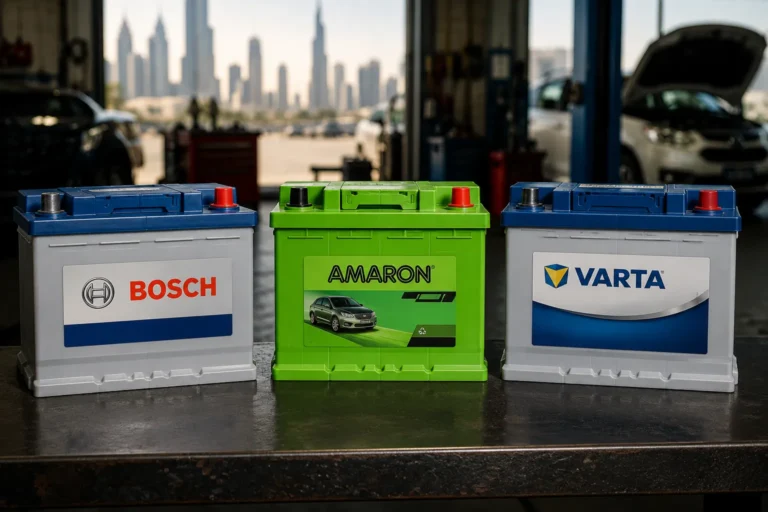
- Battery replacement: Roughly AED 250–650 for most sedans and small SUVs, depending on brand and battery type (standard, EFB, or AGM). Larger SUVs and vehicles with start-stop systems that require AGM batteries sit toward the higher end.
- Starter motor replacement: Typically AED 400–1,200 including labor, though luxury and less common vehicle models can run higher due to part availability.
- Alternator replacement: Usually the most expensive of the three, ranging from AED 600–1,800, again depending on the vehicle.
The financial trap is replacing the wrong part first. A misdiagnosed battery swap on a car with a failing alternator means you pay twice — once for a battery you didn’t need yet, and again shortly after for the alternator that actually caused the problem.
Two Things That Aren’t Any of the Above
Before you commit to a diagnosis, rule these out — they’re common enough to mention:
A drained battery from something you did. Left the headlights on overnight, an interior light stayed on, or a phone charger kept drawing power with the car off. This looks identical to a genuinely dying battery, but a jump-start fully resolves it and the car behaves normally afterward with no recurrence. A truly failing battery, by contrast, will show the same symptoms again within days.
Fuel or immobilizer issues. If the engine cranks completely normally — full power, normal cranking sound — but simply won’t catch and run, that’s not an electrical starting problem at all. That points toward fuel delivery or, on newer vehicles, an immobilizer/key fob communication issue. Different diagnosis, different fix.
The Fastest Way to Know for Sure
Here’s the honest answer: the headlight test and symptom pattern above will get you 80% of the way to a correct diagnosis, but a proper load test on the battery and a voltage check on the alternator while the engine is running is the only way to be certain — especially in that overlap case where a dying alternator has already drained the battery and both look guilty at once.
That’s the value of a mobile diagnostic visit rather than guessing and hoping. Our technicians carry the same load-testing equipment used in a workshop, so instead of towing the car somewhere to find out, we can test the battery, starter engagement, and alternator output right where you’re parked — home, office, or roadside — and tell you exactly which part is actually failing before you spend a single dirham on the wrong fix.
Frequently Asked Questions
Can a bad alternator drain a good battery?
Yes, and it will do this consistently. If your battery keeps dying even after you’ve replaced it, the alternator is very likely the real problem — a fresh battery with a failing alternator will discharge the same way the old one did.
Why does my car sometimes start fine and sometimes not?
Intermittent starting is a classic sign of either a weakening starter motor with worn internal contacts, or a battery with a bad internal cell that only fails under certain temperature or load conditions. It rarely means “nothing’s wrong” — intermittent problems tend to become permanent ones.
Can I jump-start a car with a bad starter?
No. A jump-start adds current to the battery, but if the starter motor itself is mechanically failing, extra battery power won’t make it engage. If a jump-start doesn’t produce any cranking sound at all, suspect the starter rather than the battery.
How long do car batteries actually last in Dubai and Sharjah?
Most batteries in the UAE last 2–3 years rather than the 4–5 years you’d see in cooler climates, mainly due to heat combined with short-trip driving patterns that don’t allow a full recharge cycle.
Is it safe to keep driving with the alternator warning light on?
Only for a short distance to get somewhere safe. Once the alternator stops charging, you’re running purely on battery reserve, and depending on your electrical load, that can be anywhere from 20 minutes to a couple of hours before the car dies completely — often in the worst possible location.
Does AC use affect which of these three fails first?
Indirectly, yes. Heavy AC use increases the electrical load on both the battery and alternator, especially in stop-and-go traffic where the alternator is spinning slower. It doesn’t cause a starter failure, but it does accelerate battery and alternator wear over time.
Can a mechanic test all three at once?
Yes, and this is exactly what should happen before any part gets replaced. A proper diagnostic checks battery voltage and load capacity, starter current draw, and alternator output under load, all in one visit.
The Bottom Line
Next time your car won’t start, resist the urge to assume it’s the battery and order a replacement on the spot. Listen to the sound, check whether your lights stay bright, and note whether the problem happened while starting or while driving. Those three observations alone will point you toward the right answer most of the time — and if you’re still not sure, a proper load test settles it in minutes rather than guesswork.
If you’re dealing with this right now anywhere in Dubai or Sharjah, get in touch and we’ll come test it properly before you spend money on the wrong part.